Using social media to acquire and use information
Lesson 1.4 Using social media to acquire and use information
In this lesson you will learn that your existing experience in using social media may be useful in information creation and sharing for study and work purposes.
The lesson has 4 units. All of the units have one or two short exercises which ask you to think about your use and opinions of social media and collaborative information sources. There are no right answers to these questions; they are intended to help you reflect on the relevance of social media to information handling for study and work, which will be helpful later in this course.
Learning objectives
At the end of this lesson, learners should have a basic understanding of:
-
the potential of social media for academic and professional information handling
-
the value of skills gained in using personal social media in handling information for study and work
1.4.1 Social media in using and creating information
You have probably used social media to communicate with your friends. Social media platforms are very widely used in many countries, though the most popular platforms may differ.

Although you may not have realised it, in doing so you will have learned some useful lessons in finding and exchanging information, which can be applied in using information for your studies. This is particularly if your classes use groupwork and collaborative learning. In particular, you will have learned:
-
how to choose the best media for communicating certain types of information
-
how to communicate quickly and effectively
-
how to go about asking for information and advice
-
how to create and share information in different formats (for example, by making and sharing videos).
All these are relevant to using information for your studies, and for work, although you may need to extend them to take in new kinds of sources and content.
Exercise - think about how you use social media. Do you mainly: create and share information?; ask for information and advice?; give information and advice?; or a mixture of all these? Do you think you would behave in the same way when you are using information for study or work?
1.4.2 Social media and choosing information
There is so much information communicated on social media that we have to find ways of choosing who we follow and interact with, and selecting the information we pay attention to. This can give us useful lessons for choosing information for study and work.
One point to be aware of is that, in the same way that we choose who to follow, friend, and interact with on social media, we need to choose the sources and formats of information that we use for study and work. This should be an active choice, not just using what we already know, or what is most obvious and convenient.
Studies show that in social media we have the effect of the "filter bubble"; we choose to read and pay attention to people and sources that we know, like and agree with. This can mean that we remain ignorant of other points of view. While this may not matter in most uses of social media, for study and work purposes we need to make sure we are reading and understand all relevant points of view,
Much use of social media is based on trust: whose opinion do you value, whose recommendations do you accept, and whose advice do you take. The same applies in using information for study and work. We need to evaluate sources of information, and choose those which are most appropriate for us. This will be covered in detail in a later lesson.
Exercise - think how you choose who to follow and interact with on social media. Could you use the same ways of choosing information sources for study and work.
1.4.3 Social media and academic information
There is now a strong overlap between social media and more traditional forms of scholarly and professional information.
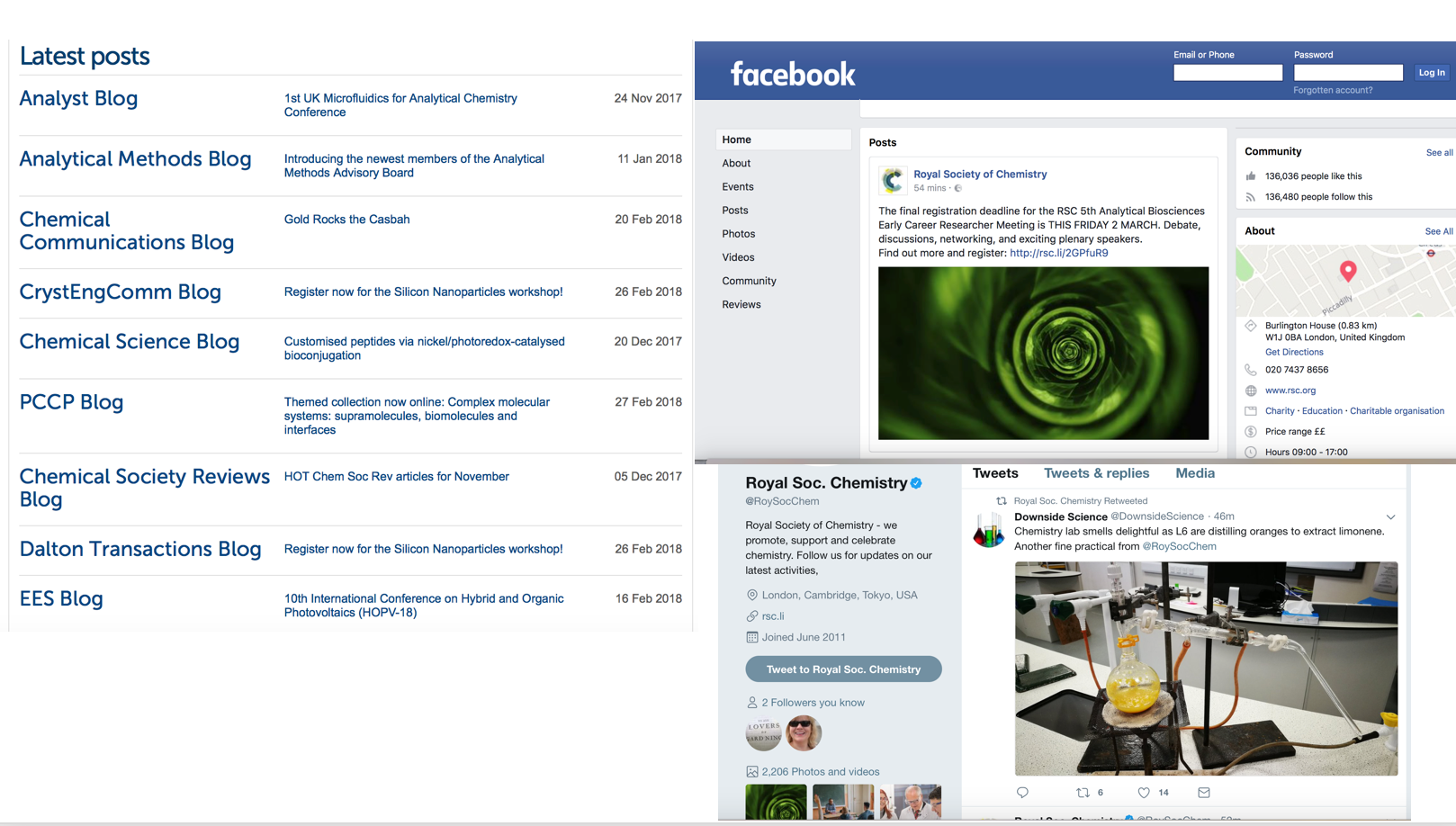
Many professors, universities and scholarly societies are on social media, particularly using Facebook and Twitter.
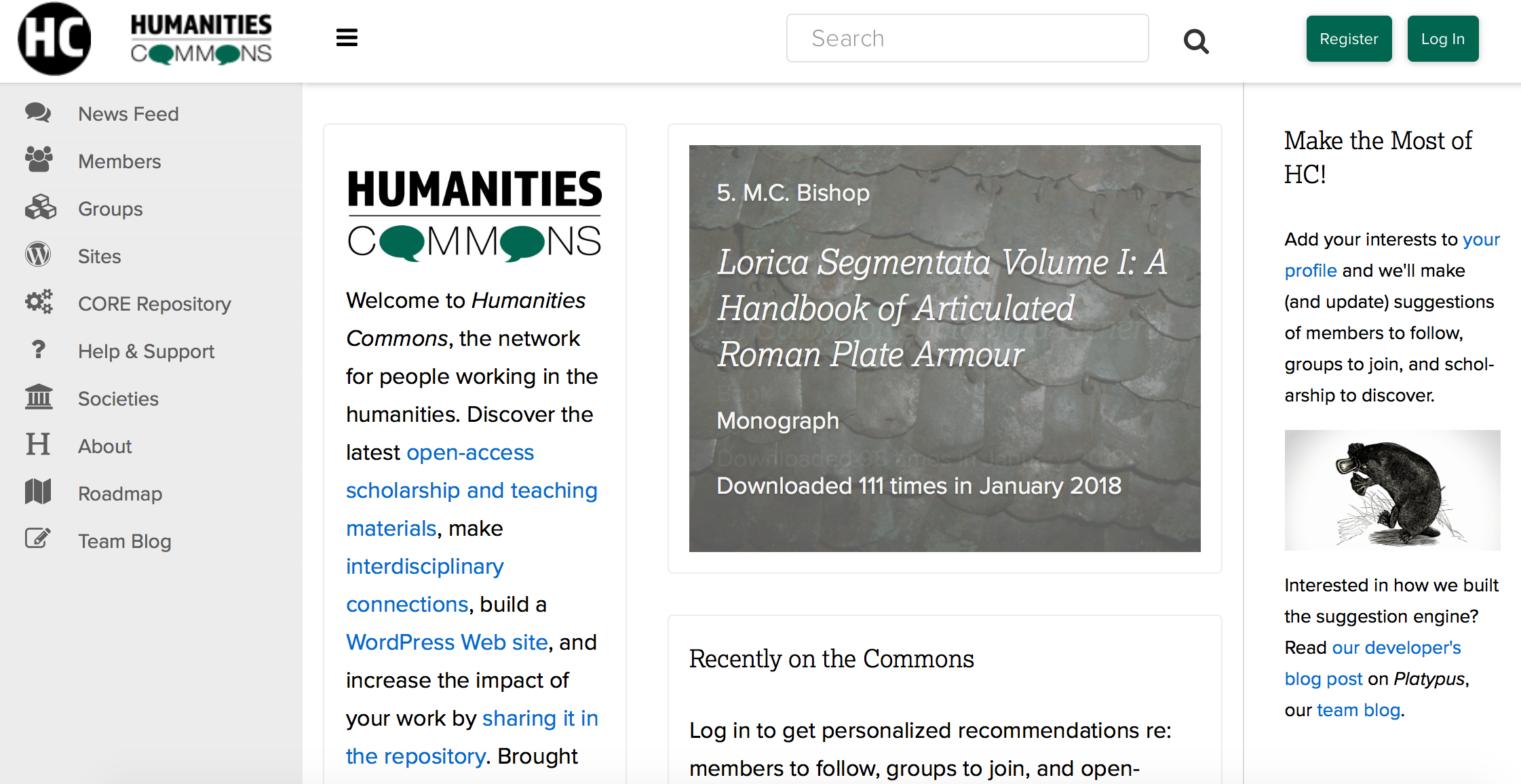
There are also sites which combine provision of information, by for example providing copies of journal articles and teaching materials, with networking through social media. A good example is Humanities Commons.
We can expect to see academic and professional communication getting more like social media in the future, and your experience of personal social media will help you to study and work in this new environment.
Exercise - find three examples of social media being used in an academic subject of interest to you; for example, the Facebook page or Twitter feed of a professor, or a university department. Look at some recent material; would it help your studies to follow them, or similar social media profiles?
Exercise - look at the Humanities Commons website. Find one of their 'groups' in a subject of interest to you, and see the kind of materials that are shared, and the way communication and interaction happens.
1.4.4 Social sources of academic and professional information
As well as the use of social media for academic and professional purposes, which we saw in the last unit, there are now new types of sources of this kind of information. We will mention two of these: wikis and blogs.
Wikis are information sources created and improved by collaboration between large numbers of interested people, in contrast to the traditional creation of such sources by a small number of experts. The best known is Wikipedia, an encyclopaedia covering all kinds of subjects. Wikipedia is one of the most-used websites on the Internet, and most of us will use it at some time. Its use is rather controversial, and some professors do not allow students to use it as a source. It has been criticised for having no consistent expert editorial checking, for allowing errors to persist for years, and for being very uneven in its coverage of topics and perspectives. However, most people would agree that it is a very useful starting point for finding information on any topic. We are likely to see more sources of this kind in the future. We should take a critical view of them, perhaps using them as a starting point, but not relying on any of them as a single authoritative source.
Blogs are another new form of resource. Many researchers and professors have blogs, and while blog posts are not reviewed and edited in the way that books and journal articles are, they often give short readable accounts of research findings or academic issues. Blog posts on specific topics will be found from general search engines like Google, or you can search for blogs on particularly blogging platforms like Wordpress, Blogger, or Tumblr. It may be worth identifying and following blogs written by experts on subjects you are interested in.
Exercise - to establish the coverage of Wikipedia, as an example of a wiki source, look up a topic related to your own country or region, in the main English-language Wikipedia. Do you think it is adequately covered? If there is a relevant regional or language variant of Wikipedia, try that, and see it its coverage is more helpful.